Our part of Northern California received heavy rain this winter. While lots of rain is a blessing to this often-parched part of the country, it resulted in quite a few gloomy days after the initial, exuberant rain celebrations had worn off. Now it’s officially spring here in the Northern Hemisphere – we made it! Apart from common religious holidays, typical springtime rituals where I live usually center around nature: everyone seems busy in their garden, tender and fresh produce begins to show up at the farmer’s markets, and folks talk about the various cute baby animals they’ve spotted: Fledglings in a bird nest! A fox kit!
When I lived in Spain, this was the time leading up to Semana Santa and all it’s gilded glory:
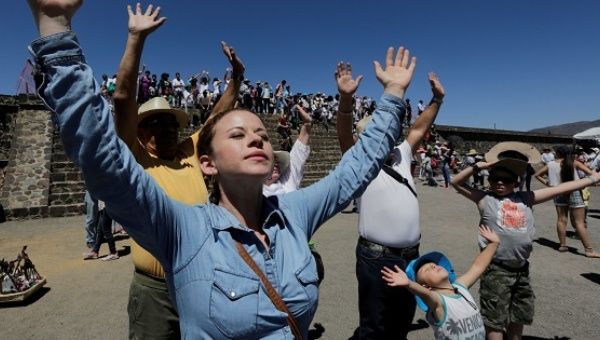
In Mexico, thousands of people dress in white and gather at the enormous Teotihuacán Pyramid, located 30 miles northeast of Mexico City. They raise their arms towards the sky to soak up energy for the year:
Costa Rica celebrates El Día del Boyero (Oxcart Driver’s Day) in early March. The colorful oxcarts seem to welcome spring:
Happy spring to you,
A.
Images courtesy of mnn.com, funeu.es, telesueenglish.net, hdqwalls.com, escazunews.com
Translating poetry is a special job: the poet, if alive, entrusts the translator to capture the soul of a poem so that speakers of a completely different language might fully understand the poet’s message; the translator is responsible for making the right decisions along the way, ensuring that this transfer of ideas happens smoothly.
Whether the author of the original poem is still alive or has passed away, it’s an honor to translate a poem! I am by no means an expert, but here are some steps that have helped me so far in this work. Here are some key decisions a translator must make during the process of translating a poem, as well as some additional inspiration:
1. What to do about structure? A translator must decide how important rhyme or rhythm needs to be. Is rhyme the most important aspect of the work? Is it non-negotiable to keep the same number of syllables in each line, or would being that strict result in forcing poor word choice? If so, perhaps it’s best to focus on best word choice and overall feel of the poem instead of being restricted and risking a loss of meaning or soul.
2. Do your research. When translating a poem, I sometimes come across a culturally specific phrase or reference that I’m not familiar with. A translator will probably need to do some deeper research in a case like this. I often turn to terminology help on ProZ.com (not an affiliate link) because fellow translators from all around the world can provide answers to the question posed. So, if you’re translating a poem from a Costa Rican poet and there is a specific word that you suspect may be very particular to that country or culture, chances are that someone from that part of the world will help you.
3. Read it over and over…and over….Print out both poems, read them over and make corrections and changes. Put the work aside for a day or two, then come back to it. You’ll find more details that you’ll want to change. Read the poem aloud as well: that helps to clarify if you’ve captured the rhythm and feel of the overall work.
Those are my top three tips for now. If you are a translator who works with poetry, take a look at the resources from Oxford Handbooks Online. If you have a resource to share, please add it in the comments!
In closing, here’s inspiration for translating poetry from writer Jennifer Liddy:
“Translating a poem is a lot like writing a poem yourself. You have to know what you want to say. You have to feel what you want to say. You have to be focused. There are a thousand other jobs that are easier, better paid, and eyesight-saving, but translating has its own glories. Putting poems into another language is one of the best ways to share culture, honor poets, and remind us that we can transcend geography. Do your best.”
What books to read in 2019?? I just finished Michelle Obama’s new memoir in Spanish. The Spanish translation was carried out by three translators, and I was impressed with their ability to capture her voice and style. I’m now re-reading Lucia Berlin’s short stories in A Manual for Cleaning Women.
A few more books I hope to read this year are…
Margaret Atwood’s new novel, The Testament,which is arriving in September.
Such Small Hands by Andrés Barba was released by a new-to-me publisher called Transit Books in Oakland, California. It was voted one of the best books of 2017 by The Guardian.
Birthday Girl by Haruki Murakami begins on a rainy night in Tokyo. I’m already hooked because the setting sounds like classic Murakami.
Cristina Rivera Garza’s The Taiga Syndromeis bringing this author into the spotlight.
Nordic noir also makes my list, especially during the chilly winter months.
Gender is a big topic these days and the use of gender-neutral language is a much-debated subject right now in the translation industry.
Translators and the people who work with them have long been debating how and when to use gender-neutral language. If conference topics and online articles are any indication, the overall global conversation about gender is bringing the topic of gender neutrality to the forefront again within the translation profession. As a Spanish to English translator, I work with two fairly “patriarchal” languages: the default pronoun still tends to be “he” in English and “‘él” in Spanish. However, this is changing as people question the default use of the masculine and come up with new ways to write and speak. Thinking about gender neutrality in translation presents the opportunity to re-think my own approach to language as I work.
Depending on the type of document I’m translating, I may choose to state “he or she” instead of just “he.” Take for example a statement by a student who writes, “Siempre me presento a un profesor nuevo para que pueda saber mi nombre de inmediato.” I could translate this to, “I always introduce myself to a new teacher so that he or she may know my name right away.” Notice that, even though the Spanish sentence uses the default masculine indefinite article “un,” I chose to use the pronouns “he” and “she” in the English sentence to open it up to both genders. It’s important to point out that this still leaves out the option of completely gender-neutral pronouns such as the use of “they” as a singular pronoun, which some folks are doing. More on all that here.
Translation companies Transpanish and Ulatus have thoughtful articles on this topic:
What is your stance? Do you have a definite preference? Does it depend on the context and purpose? What do you think of the new use of the “@” symbol for Spanish words like “tod@s” or Latin@s,” or the English use of neutral pronouns like “Ey/em/eir/eirs?”
One of the big winners this year at the Latin Grammys was Rosalía Vila Tobella, a 25-year-old Spanish singer-songwriter from Catalonia, Spain. Wait – you ask. A flamenco singer….from Catalonia?? Yes, A flamenco singer from Catalonia who is bringing her own style of “nuevo flamenco” mixed with hip-hop and pop to the forefront. Many say Rosalía is a big reason we’re all talking about flamenco again, and that she’s getting a new generation excited about this tradition by mixing the music up in new ways. I couldn’t agree more.
When I first heard her music and saw her videos, I knew she had captured both traditional Spanish feeling and icons as well as the sound of a new, young generation. This generation has come of age in a Spain that’s very different from that of their parents and grandparents. In some ways it’s a very different Spain from even ten or twenty years ago. Rosalía successfully combines both new and old. One reviewer from Pitchfork describes her work well:
“One approach—a very successful one—lies in El Mal Querer, the relentlessly gorgeous album from Rosalía Vila Tobella, a 25-year-old Spanish singer with one foot steeped in her Catalan history and the other hypebae-sneakered foot sidling into the future. Rooted in flamenco—the Arabic-influenced Andalusian music which she has studied since a young age—El Mal Querer is a dramatic, romantic document that seamlessly links that tradition’s characteristic melodrama to the heart-wrenching storytelling of modern, woman-flexing R&B. Flamenco music carries the sound of Spanish history within it—you can practically hear the migration patterns—and Rosalía uses it to tell the story of a doomed relationship across 11 songs, each one serving as a new chapter. It is one of the most exciting and passionately composed albums to appear not only in the global bass tradition but in the pop and experimental spheres this year.”
I really respect Rosalía’s study of flamenco and what she brings to the genre. Some people say that, being from Northern Spain, she has no business representing the traditionally Southern Spanish sound of flamenco. Whatever!! Here is the popular track from El Mal Querer: “Malamente.”
If someone told you to no longer use the word “burrito” to describe beans, rice, lettuce and cheese wrapped up in a tortilla, what would you do? It is commonly thought that the word “burrito” comes from the fact that, like a little donkey that can carry many items on its back, a burrito carries lots of different ingredients all together.
I hereby give you permission to look up more cute donkey pictures online.
This is a simplified example, but as a Spanish to English translator I am faced with these conundrums on a regular basis. We as a global species are exchanging more goods and services across our self-imposed borders than ever before. Language reflects those who speak it, so naturally you’re going to hear someone in Spain use the word “Bluetooth” when setting up a stereo system. You’ll hear someone here in the U.S. say he’s buying a “piñata” for a party. Let’s not even try to come up with another word for “dim sum!”
This is all to say that we as translators walk a fine line between being true to our target language (the language we’re translating into) and retaining the soul of the original text. I enjoy finding out about how other translators navigate this cultural and linguistic space.
A lot of folks have very strong opinions about this topic, especially people in Spanish-speaking countries who see those using Anglicisms as a way to seem “cool”. Being from California where many of our everyday words are from Spanish, I’m all for using borrowed words in my speech. In general I agree with this article from the New York Times opinion columns. That being said, more formal document translation is a different beast: if there is a succinct and obvious word in English that will describe a Spanish word, I will use it.
Here are some examples of Spanish words that I would borrow while speaking, but would change to a specific English word when translating a document:
Bodega: I would say “bodega” to refer to a convenience store on the East Coast, and would translate it as “cellar” for most other purposes.
Embarcadero: I would use this if it was a specific name, and otherwise would translate it as “boat dock.”
Federales: Country music fans will agree that we and Willie Nelson will always use this Spanish word for the most part, but in writing I may translate it as “federal police.”
Incomunicado: I would translate this to “unable to be reached,” “out of touch” or perhaps even “M.I.A.”
Pronto: I would say “pronto” in a conversation, and would translate it as “quickly.”
Reconquista: I would translate this as “reconquest.”
What are some common words you use that come from a different language? If you’re a translator, do you have a hard stance on this topic?
For an fun list of Spanish words borrowed by English speakers, check out this site, and for an infographic of common Anglicisms and their real Spanish equivalents, see this site. The Cervantes Institute recently published this dictionary of Anglicisms among Spanish speakers in the U.S. and the dictionary portion begins on page 37 of the document.