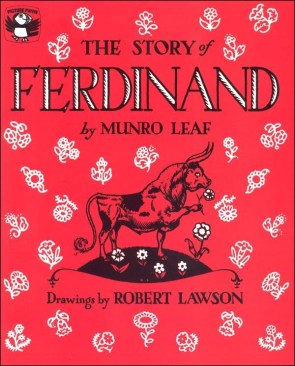
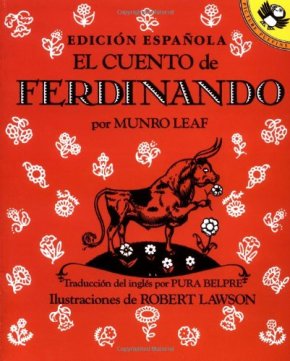
A confession: For years when I taught Spanish I would read El cuento de Ferdinandoaloud to my students. For some reason I always thought the original was written by a Spanish author and only recently discovered that Munro Leaf and Robert Lawson are not the translators but the original American authors of this famous children’s book.
The book was translated to Spanish by Pura Belpré of the Pura Belpré Award. I really don’t know how I missed this one…must have been too busy to telling everyone to sit “criss-cross applesauce” and waiting for someone to come back from the bathroom! The Spanish version is still my favorite, having read those first famous words so many times: “Érase una vez un toro que se llamaba Ferdinando que vivía en España…”
Disney came out with a movie based on the book. Did you see it? The original Disney mini-film is very cute. The themes of the story resonate with me and are great for kids – stay true to yourself, don’t judge a book by its cover.
As far as the subject of bullfighting goes, while I respect the historical significance of this tradition, I am not a supporter of bullfighting in our modern times. I stand with Catalonia and over half of Spaniards on this one! You can read my post about bullfighting here.
Have you read Ferdinando? Any other classic tales that are ingrained in your memory from childhood or now as an adult? ¡Que viva el toro!
Here we are, nearing the end of March. Spring has sprung in my corner of the world: birds singing, green grass sprouting, and new wildflowers every day. It’s on days like this that I’m thankful we made the move to the country! To celebrate Women’s History Month I’ve been focusing on women in the arts here on the blog. You can read my previous post about Latin American women writers here. For the second half of my two-part series I’m going to highlight three relatively contemporary women artists from Latin America worth knowing about.
Ana Mendieta was a Cuban-American artist born in 1948. The site “The Art Story” has a true description of her work, stating that her art is an “ongoing dialogue between her own body and the landscape regarding presence, absence, and the inevitable cycles within nature and life.” Her work that most moves me is her “Silueta” (“Silhouette”) series.
Yolanda Andrade is a street photographer from Mexico. She juxtaposes the gritty with the glamorous, the in-your-face with the mysterious. In essence, she captures Mexico. Her photograph here, entitled “La Esquina,” is typical of her style as she shows a chaotic moment on a busy street corner that also inspires us to pause and reflect on the spiritual, as referenced by a “Last Supper” painting being carried over a man’s shoulder.
María Camila Bernal Toro goes by the artist name “Remedios.” Her choice is appropriate because it means “Remedies”, and viewing her paintings is like taking in a huge breath of fresh air. She’s originally from Colombia and now lives in Panamá. You can see how her background in graphic design informs these paintings. She’s inspired by nature and organic forms; her brilliant colors are beautiful.
Well, enjoy the rest of Women’s History Month! By the way – did any of you out there see or read reviews of the colossal “LA/LA” exhibition led by the Getty about Latin American and Latino art?
To celebrate Women’s History Month I thought it would be fun to share a short list of popular Latin American women writers, both classic and contemporary. This is the first of a two-part article, with part two focusing on female artists.
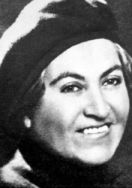
Gabriela Mistral, born 1889. Chilean poet who also taught elementary school for many years and later taught at U.S. universities. Her collection of poems entitled Sonetos de la muerte earned her a loyal following from outside her home country.
Elena Poniatowska, born 1932. Known as Mexico’s “grand dame of letters.” I recently read her 2001 novel La piel del cielo and loved it. She’s also worked as a journalist. Feminist, activist, winner of multiple literary awards.
Gioconda Belli, born 1949. Nicaraguan poet who was born a “society woman” and then became a member of the Sandinistas. The Inhabited Woman is worth a read.
Samanta Schweblin, born 1978 in Buenos Aires and currently living in Berlin. Her book Fever Dream was shortlisted for the 2017 Man Booker International Prize.
Valeria Luiselli, born 1983, is a Mexican author. She currently lives in New York. Her collection of essays, Sidewalks, was published in 2014 and is on my must-read list.
Okay, stay tuned for women artists later on this month!
Images courtesy of Newsday, The LA Times,Univ. of Maryland, Festival Internacional de Poesía de Granada and The Diplomat in Spain.
I recently translated a great loan for Kiva.org in which a Guatemalan woman was seeking a loan to purchase traditional huipiles (tunics), fajas (wraps), and cortes (skirts) to sell. The very next morning while listening to the radio I learned about a revival and strengthening of weaving traditions in Guatemala among a group of young indigenous women who have taken it upon themselves to learn the craft of weaving on a backstrap loom as their ancestors did.
Weaving on a backstrap loom.
This may come as a surprise to those who think that traditional weaving techniques are still a “given” in Guatemala’s indigenous communities. In fact, according to journalist Anna-Cat Brigida, the number of women who learn weaving from older family members has dwindled. Many young women don’t have a family member who can teach them how to weave. Many textiles that visitors to Guatemala buy are made in factories, so this new resurgence of learning is a bright spot on the horizon.
Two very different methods.
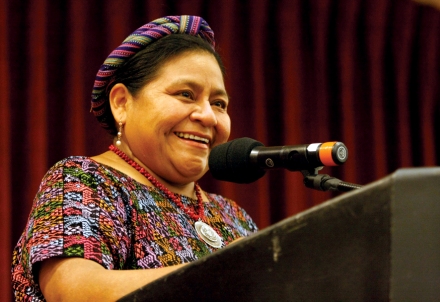
If you know about the history of indigenous peoples in Guatemala, you know that they have fought long and hard to keep their dignity and traditions, which hail from their Mayan roots. One of the most famous individuals to share her people’s plight with the world is Rigoberta Menchú Tum, an indigenous Mayan Quiche woman from Guatemala who won the Nobel Peace Prize in 1992 and wrote the novel I, Rigoberta Menchú. Her personal story brings to life the terror of a 36-year Civil War that ended in 1996. In perhaps one of the most famous passages in the book she states, “This is my testimony. I didn’t learn it from a book and I didn’t learn it alone. I’d like to stress that it’s not only my life, it’s also the testimony of my people. . . . My story is the story of all poor Guatemalans. My personal experience is the reality of a whole people.”
Rigoberta Menchú Tum
Journalist Anna-Cat Brigida’s story about the revival of Guatemalan weaving traditions is an example of one way that indigenous Guatemalan women are reclaiming their identity in the face of a culture that increasingly pressures them to “fit in” by wearing Western clothing. One woman in the story tells of a time when she worked cleaning houses in the city and endured teasing and negative comments from the other employees because of her traditional clothing. As she got older, she decided that it was important for her to learn to weave her own clothing and to wear her community’s traditional dress with pride. (It is much more cost-effective for women to weave their own clothes if they know how to, as factory-made clothing of this type can be expensive and of lesser quality).
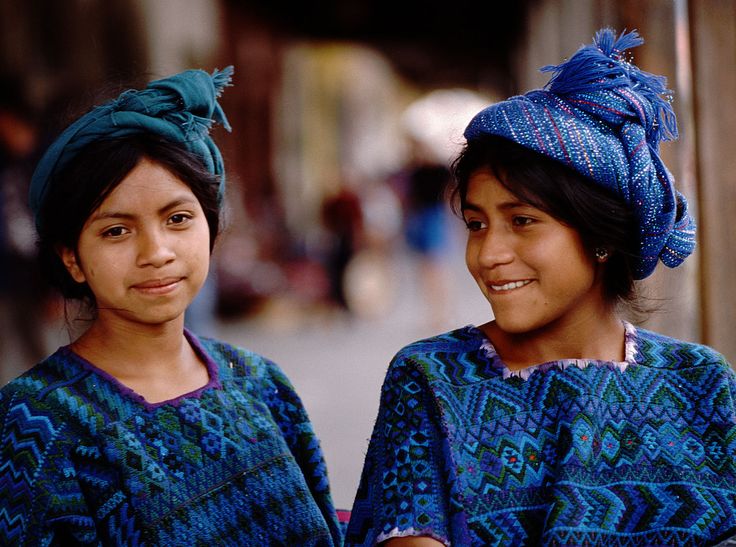
Two girls from Santa Catarina Polopó near Lake Atitlán
Like in other regions such as Oaxaca, Mexico, each community in Guatemala has its own textile designs. While larger manufacturers might combine different images and patterns into their clothing, individual women usually make clothing that contains images specific to their own community: a bird or other animal, a local plant, or even specific colors. Now, some women are taking classes to learn how to weave so that they can carry on these traditions, even though their mothers or grandmothers do not know the craft.
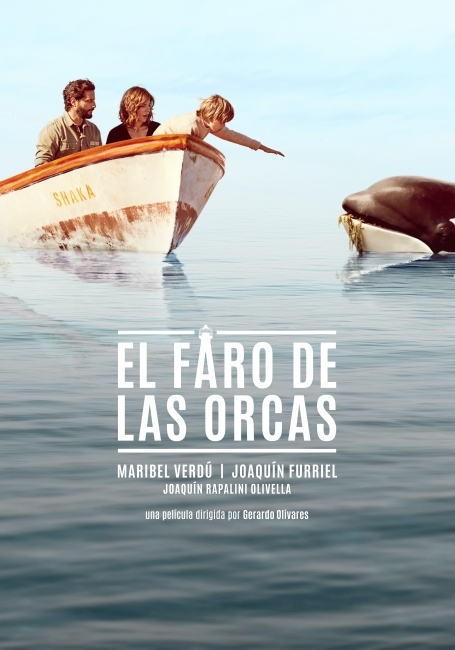
It seems I’ve been on a bit of a Patagonia tangent lately, if this post and my last post are any indication! I saw a great movie this month called “El faro de las orcas,” or “The Lighthouse of the Orcas.”
This is a beautiful film that captures life at the edge of the world along the coast in Patagonia. It tells the based-on-true-life story of a man who lives and works at the lighthouse studying orca whales. A woman and her autistic son come to visit him from Spain after hearing of his work in the hopes that the son’s emotions can be calmed by spending time with the whales.
You can read a longer review of the movie here, watch a trailer here, and learn about the real-life protagonist of the story here.
Feliz Año Nuevo. How did you celebrate the new year? Did you eat 12 grapes or pop a bottle of champagne? We enjoyed a seafood dinner at home and wine from Fort Ross Winery, our neighbor up the road.
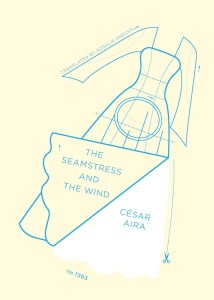
This week I started reading The Seamstress and the Wind by Argentinean author César Aira. The translation is by Rosalie Knecht. I’m new to Aira’s work and this short novella had me tucked neatly into it’s story from the start.
César Aira. “She told me she worked in the morning and started to laugh, I told her I didn’t and crawled off to sleep in the bath.”
The characters in this novel live in a small, dusty town where folks keep tabs on each other and much speculation is made as to the comings and goings of fellow inhabitants. The protagonist, a man recalling his years as a young boy living in the town, describes country life in detail, from the specific bird calls heard at four in the morning to the obsessive cleanliness of a neighbor as she sweeps her front and back porches multiple times each day.
After her son disappears, the local seamstress is caught up in a voyage across the windy, vast spaces of Patagonia. Aira’s first description of this land is beautiful:
“The abyss that opened before Delia Siffoni had (and still has) a name: Patagonia. When I tell the French I come from there (barely lying) they open their mouths with admiration, almost with incredulity. There are a lot of people all over the world who dream of some day travelling to Patagonia, that extreme end of the planet, a beautiful and inexpressible desert, where any adventure might happen.”
Patagonia
I won’t spoil the plot so I’ll leave it at that. I look forward to reading more by César Aira. He’s a prolific author so we have no shortage of titles to choose from. There’s a nice list of his works here on IndieBound.