The Price of Forgetting

What is the price of forgetting? “The Silence of Others” tells us that, for many parts of history, the price of “forgetting” is too high.

“Es simplemente un olvido. Una amnistía de todos para todos. Un olvido de todos para todos. Una ley puede establecer el olvido, pero ese olvido ha de bajar a toda la sociedad. Hemos de procurar que esta concepción del olvido se vaya generalizando porque es la única manera de que podamos darnos la mano sin recor.”

“It’s simply a forgetting. An amnesty by all, for all. A forgetting by all, for all. A law can establish a forgetting, but that forgetting must filter through all of society. We must ensure that this forgetting becomes widespread because it is the only way we can shake each other’s hands without rancor.”

In the film “The Silence of Others”, we see 1977 video footage of these words spoken by a member of the Congress of Deputies, Spain’s legislative branch that meets in the Palace of the Parliament. These words refer to Spain’s Amnesty Law, which placed a final end to Franco’s dictatorship in Spain but also, with the “Pact of Forgetting” (in Spanish, “el Pacto del Olvido”) wiped out the possibility of seeking justice for the thousands of Spaniards who suffered through disappearances, torture, the kidnapping of babies and many other crimes against humanity from 1936 to 1976.

This documentary is beautiful and heartfelt, full of both pain and hope. Much like here in the U.S., we have learned that the price of “forgetting” is too high. As we follow Spanish men and women of all ages—who lost family members or who were tortured themselves—take part in an international tribunal that seeks to bring perpetrators to justice, we learn their stories and how important it is for them to have some semblance of closure.

María Martín, one of the many Spaniards who has fought to exhume her family member’s remains from a mass grave.

An overall theme of the film is also the questioning of those monuments, streets and other public spaces emblazoned with the names of the Franco regime’s fascist leaders. We see footage of present-day nationalist movements in Spain today, with citizens chanting “Viva Franco, Viva España” while raising their right hands in the air a la Nazi youth. This, too, mirrors what I see happening in my own country.

These statues are a monument to those who suffered under the Franco regime. Shortly after their unveiling, someone shot at them. You can still see the bullet holes.

For an insightful look into these individual Spaniards’ stories and into the historical reckoning that many people in Spain now seek, I highly recommend this movie. It’s currently available on Netflix, and there are subtitles. Whether you live here in the U.S. like me or elsewhere, my guess is that you will see some of your own country in these scenes. Please let me know what you think if you watch it! I’m curious to hear other peoples’ takes.

Photos courtesy of the East Bay Express and Latino Public Broadcasting.

68 Voces

Image from 68 Voces
Summer “hellos” to everyone. A recent discovery I have to share with you today is 68 Voces (68 Voices). This art and storytelling project is the brainchild of Gabriela Badillo, an artist based in Mexico City. It’s a compilation of animated stories from Mexico’s diverse indigenous regions…all narrated in the original indigenous languages. Subtitles are in Spanish, and there is also a collection of stories in English. Beautiful.


Also art-related, do you now anyone who needs a nudge to wear a mask? Share this poster with them. It’s available in 19 languages and from the fab Portland, Oregon artist Maggie Rudy. Hope you’re enjoying summer, wherever this finds you. 

Alison

Bienvenida y respaldo: de qué manera pueden reclutar y respaldar a los estudiantes estadounidenses las universidades españolas y latinoamericanas, tercera parte

To read this post in English, click here.

Esta semana presento el último artículo de la serie que consta de tres partes y se denomina: “Bienvenida y respaldo: de qué manera pueden reclutar y respaldar a los estudiantes estadounidenses las instituciones educativas españolas y latinoamericanas”. En la primera publicación analizamos las estrategias de reclutamiento. En la segunda publicación hablamos sobre el apoyo a los estudiantes una vez que estos llegan a sus países anfitriones. El artículo de hoy está destinado a considerar cómo pueden mantener el vínculo las universidades de España y América Latina con sus exalumnos internacionales de habla inglesa, para lograr que hagan correr la voz acerca de los beneficios de sus programas y ayuden a mantener elevadas las tasas de inscripción.

Staying connected.

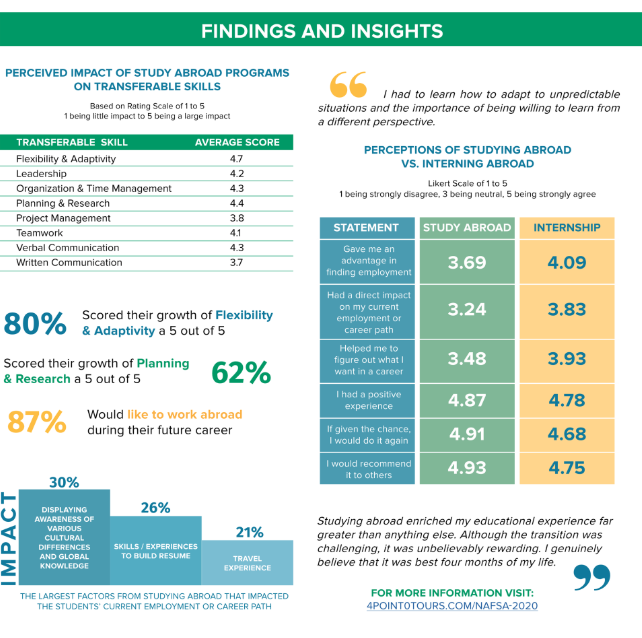
Si hace un seguimiento de los exalumnos para saber de qué manera les cambió la vida y aumentó su conjunto de habilidades la experiencia de estudio en el extranjero, sabrá de qué hablar con los posibles estudiantes que vengan después. El seguimiento también le ayudará a entender qué mejoras puede implementar en su programa con vistas a un crecimiento futuro. Samantha DiBacco de 4.0 Tours comparte algunas perspectivas que obtuvo su empresa cuando midió el impacto de las experiencias de estudio en el extranjero, especialmente en Europa, en el caso de sus exalumnos:

Findings and Insights

La realización de una encuesta propia con los exalumnos y la posibilidad de compartir ese conocimiento profundo son cosas que resultan realmente beneficiosas, por ejemplo para futuros alumnos y sus padres.

Además, considere las estrategias para conectarse con los exalumnos a través de las redes sociales. Los boletines informativos por correo electrónico son un buen comienzo, pero los destinatarios no siempre los leen. Tener un grupo en LinkedIn para exalumnos extranjeros o una cuenta de Twitter o Instagram específica para los exalumnos internacionales le ayudará a crear una comunidad una vez que estos alumnos completen sus estudios en su campus.

Por último, considere tener un contacto con los exalumnos que pueda desempeñarse como anfitrión si alguno de sus alumnos extranjeros regresa de visita. Esta persona también puede establecer vínculos durante cualquier esfuerzo de recaudación de fondos que realice más adelante. Es habitual que las universidades estadounidenses se pongan en contacto con los exalumnos cuando surge la necesidad de recaudar fondos y realizar campañas de capital. Esta es otra forma en la cual puede mantenerse en contacto con los estudiantes anteriores.

A medida que nos adentramos en este territorio desconocido en el cual los viajes internacionales y las experiencias de estudio en el extranjero resultan tan afectadas por la pandemia del coronavirus, las universidades de España y América Latina tienen una oportunidad inigualable de vincularse de manera eficaz con los estudiantes estadounidenses que desean formarse en sus campus durante del 2020-2021 o más adelante. El objetivo es lograr que los estudiantes se sientan “como en casa”, bienvenidos y a gusto. Esto será beneficioso tanto para las universidades como para los estudiantes extranjeros.

Quiero agradecer a 4.0 Tours la generosidad que tuvo al compartir sus perspectivas y permitirme usar sus hallazgos en esta publicación.

Welcome and Support: How Universities in Spain and Latin America Can Effectively Recruit and Support U.S. Students, Part 3

Para leer este artículo en español, haz clic aquí.

This week is the last article in my three-part series called “Welcome and Support: How Educational Institutions in Spain and Latin America Can Effectively Recruit and Support U.S. Students.” The first post discussed recruitment strategies. The second post was all about how to support English-speaking students after they arrive in your country. Today’s article is about how universities in Spain and Latin America can stay connected to their English-speaking, international alumni in order to help spread the word about programming and keep up enrollment.

Staying connected.

Following up with your alumni as to how their study abroad experience changed their lives and increased their skill set will help you know what to talk about with future potential students. It will also give you insight as to what improvements your program can make for future growth. For example, Samantha DiBacco of 4.0 Tours shares insights her company gained when measuring the impact of their alumni’s study abroad experiences in Europe.:

Findings and Insights

Carrying out your own alumni survey and sharing out those insights is really beneficial for all involved, such as future students and their parents.

In addition, consider social media strategies to connect with alumni. Email newsletters are a good start, but are not always read. Having a LinkedIn group for study abroad alumni or a specific Twitter or Instagram feed for your international alumni creates community after the time on your campus is complete.

Finally, think about having an alumni contact representative that can play host if anyone comes back to visit. This individual can also reach out during fundraising efforts in the future. It’s typical for universities in the U.S. to reach out to their alumni base for fundraising efforts and capital campaigns. This is another way you can stay connected with prior students.

As we enter these uncharted waters when international travel and study abroad experiences are so deeply affected by the Coronavirus pandemic, universities in Spain and Latin America have a golden opportunity to effectively connect with U.S. students who either have plans on hold to study abroad or who plan to study abroad in 2020-2021. Become a “home away from home” where students will feel welcome and comfortable. This will benefit all involved.

Thanks to 4.0 Tours for sharing your insights and allowing the use of your findings for this post!


Bienvenida y respaldo: de qué manera pueden reclutar y respaldar a los estudiantes estadounidenses las universidades españolas y latinoamericanas, segunda parte

To read this article in English, click here!

¡Hola! Aquí estoy de nuevo. Espero que se encuentre bien mientras comenzamos el verano aquí en el hemisferio norte y el invierno en el hemisferio sur. La publicación de hoy es la segunda de una serie que consta de tres partes y se denomina: “Bienvenida y respaldo: de qué manera pueden reclutar y respaldar a los estudiantes estadounidenses las instituciones educativas españolas y latinoamericanas”. Como mencioné en la primera parte de esta serie, los viajes internacionales cambian día a día debido a la COVID-19, y esto afecta de manera directa a los estudiantes que planean viajar para estudiar en una universidad extranjera. En esta serie se analizan las estrategias de comunicación que pueden utilizar las universidades de España y América Latina para reclutar y respaldar a los estudiantes universitarios estadounidenses tanto ahora como en el futuro. Gran parte de lo que se comenta también será de incumbencia para los estudiantes que lleguen desde Canadá, Australia y otros países de habla inglesa.

En esta segunda publicación, comentaré algunas de las formas en las cuales las universidades de España y América Latina pueden respaldar con éxito a los estudiantes internacionales de habla inglesa que reciban. Muchas organizaciones asociadas que trabajan con las universidades, como ASEPROCE en España y UDUAL en América Latina, detallan cómo esperan que las facultades afiliadas respalden a los estudiantes internacionales.

Students
Aprendizaje y preparación en grupo.

Hablo desde mi propia experiencia. No me malinterprete, cuando estudié en el extranjero como estudiante universitaria en España, me resultó imperioso involucrarme y usar el español para comunicarme con los profesores y con mis compañeros, buscar un departamento y trasladarme de un lugar a otro. Me encantó cada minuto de esa experiencia (en su mayor parte). No obstante, mi cohorte tenía la posibilidad de recibir clases de español durante el primer mes en el país y se nos vinculaba con estudiantes universitarios locales que pudieran mostrarnos la ciudad y responder algunas de nuestras preguntas, como: ¿Qué vecindarios son más adecuados para los estudiantes? ¿Adónde debo dirigirme si me enfermo? ¿Hay descuentos para estudiantes en determinados negocios? Me resultó muy útil saber que había alguien a quien pudiera pedirle ayuda.

En la reciente conferencia en línea de NAFSA, tres directores de Admisiones Internacionales y Servicios para Estudiantes de la Universidad Drexel, la Universidad de Boston y la Universidad de Indiana comentaron algunas acciones que obtuvieron buenos resultados en sus campus. Aquí presento cuatro de las estrategias que implementaron:

  1. Enviar mensajes por correo electrónico automatizados y personalizados a los estudiantes antes de su experiencia de estudio universitario en el extranjero y durante su estadía.
  2. Ofrecer una reunión virtual en el mes de mayo para los estudiantes que viajan al campus en el otoño. Realizar presentaciones entre los estudiantes y las personas con quienes se vincularán una vez que lleguen.
  3. Asegurarse de que las demás oficinas del campus sean conscientes de los desafíos que pueden enfrentar los estudiantes internacionales. Informar a las personas que trabajan en dichos departamentos para que sepan a quiénes deben remitir a los estudiantes internacionales.
  4. Considerar el empleo de una persona que se desempeñe como el punto de contacto principal entre los estudiantes internacionales y el personal académico para permitir la transmisión de consejos rápidos y coherentes a los extranjeros.

Si está buscando una idea acerca del tipo de actividad que podría ofrecerles a los estudiantes cuando lleguen a su país y se instalen, considere seguir el modelo de orientación idiomática y cultural que usan algunas universidades: los estudiantes pasan algunos días en la ciudad anfitriona, acompañados por expertos locales y docentes del idioma local. En este período, practican el idioma y obtienen más información sobre la cultura local.

Ecuador
De paseo en Ecuador.

Espero que alguno de estos consejos le ayuden a pensar en formas eficaces de respaldar a los estudiantes de habla inglesa que lleguen a su universidad. ¡No dude en comentarme si algo de lo que hace en su campus funciona especialmente bien!

¿Escuchó hablar acerca del “derrumbe de inscripciones”? Las inscripciones futuras son un tema candente en la actualidad universitaria de todo el mundo. Mi tercera y última publicación en esta serie será acerca de cómo mantener el contacto con el alumnado internacional, para que pueda mantener el vínculo con la institución (y tenga mayores probabilidades de recomendar su universidad a estudiantes de los EE. UU. y de otros países de habla inglesa que deseen estudiar en el extranjero en el futuro, lo cual tendrá, a su vez, un efecto positivo sobre su tasa de inscripciones).


Welcome and Support: How Universities in Spain and Latin America Can Effectively Recruit and Support U.S. Students, Part 2

Para leer este articulo en español, ¡haz clic aquí!

Hello again! I hope this finds you well as we head into summer here in Northern Hemisphere and winter in the Southern Hemisphere. Today’s post is the second in a three-part series called “Welcome and Support: How Educational Institutions in Spain and Latin America Can Effectively Recruit and Support U.S. Students.” As I mentioned in the first part of this series, international travel is changing every day due to COVID-19, and this directly affects student travelers that plan to study at a university abroad. This series discusses communication strategies that universities in Spain and Latin America can use to recruit and support U.S. university students at this time and in the future. Much of what’s discussed will also pertain to students arriving from Canada, Australia, and other English-speaking countries.

For this second post, I’m sharing ways that universities in Spain and Latin American can successfully support their international students who speak English. Many partner organizations that work with universities, such as ASEPROCE in Spain and UDUAL in Latin America, detail how they expect member schools to support international students.

Students
Learning and preparing together.

I speak from first-hand experience. Don’t get me wrong, when I studied abroad in Spain as a college student, it was imperative that I jump in and use my Spanish to meet professors and other students, find an apartment, and navigate my way around. I loved every minute of that (mostly). That being said, my cohort was offered Spanish classes during our first month in-country, and we were connected with local college students who could show us around and answer questions, such as: Which neighborhoods are student-friendly? Where do I go if I get sick? Are there student discounts at certain businesses? Knowing there was someone I could reach out to was really helpful.

At the recent NAFSA online conference, three directors of International Admissions and Student Services from Drexel University, Boston University, and Indiana University shared actions that work well on their campuses. Here are four strategies they’ve put into place:

  1. Send both automated and personalized emails to students before and during their study abroad experience at your university.
  2. Consider offering a virtual meeting event in May for students coming to your campus in the fall. Introduce them to the people they will connect with once they on arrive.
  3. Make sure that other offices on campus are aware of the challenges that international students may face. Tell the people who work in those departments who they should refer international students to.
  4. Consider having one person who is the main point of contact for international students and scholars to receive quick and consistent advising.

If you’re looking for an idea of what type of activity to offer students when they first arrive and are getting settled, consider following the language and culture orientation model that some universities use: Students spend a few days in their host city, accompanied by local experts and language teachers, practicing the language and learning more about the local culture.

Ecuador
Strolling in Ecuador.

I hope some of these tips help you to think of effective ways to support the English-speaking students at your university. Let me know if you do anything that works particularly well on your campus!

Have you heard about the projected 2025 “enrollment cliff”? Future enrollment is a hot topic right now at universities around the world. My third and final post in this series will be about how to maintain contact with your international alumni so that they remain connected to your institution — and are more likely to recommend your university to future study abroad students from the U.S. and other English-speaking countries, thus having a positive effect on your enrollment.