Keep it Simple: The rise of “plain language”

Have you ever gone cross-eyed reading your insurance documents? How about a legal topic that should seem straightforward but is filled with words and acronyms you don’t understand? The plain language movement aims to help people to actually understand what they are reading, with a new International Organization for Standardization (ISO) standard called “Plain language. Part 1: Governing principles and guidelines.”

This is an important topic for translators because we often put a lot of effort into making sure to translate original “wordy” documents in a way that makes them less intimidating, thus more accessible, for the reader. The International Plain Language Federation states: “A communication is in plain language if its wording, structure, and design are so clear that the intended audience can easily find what they need, understand what they find, and use that information.” I think this move to accessibility will benefit us all.

UC Berkeley’s Department of Digital Accessibility points out easy ways to use plain language, such as considering your audience and using an active voice. For these tips and more, visit the Department of Digital Accessibility’s webpage, “What is plain language?” Another organization, Plain Language Association International, also has great resources. Cheers to keeping it simple!

Getting Ready for Giving Tuesday

Does your organization celebrate Giving Tuesday? It’s coming up next month! Around the world, the first Tuesday in December will be a day when fundraising takes center stage. If your company is asking for support on Giving Tuesday, are you reaching out to your whole community in this effort? Do people understand your message? Consider translating these outreach efforts and  “calls to action:”

►Social media posts

►Newsletters and other email blasts

►Text on images

►Captions for video clips

Here’s a video with more strategies for making your #GivingTuesday a success (available in both English and Spanish):

Translation and Interpretation in Education: How to Improve Outcomes for All

In K-12 schools, events like parent-teacher meetings and back-to-school gatherings take place at this time of the school year. Translators and interpreters help with a lot of these events, as well as written communications to families. This month, I’ve been translating Individualized Education Programs (IEPs) and letters sent to parents. I also recently interpreted at a speech-language assessment meeting for an elementary student and a teacher-parent meeting for a high school student.

So, how do we ensure great communication between families and schools? No matter what language is being spoken in these meetings or needed for translation, there are a few key things that all involved can do to improve outcomes for kids, families and teachers.

  1. School staff: Assess a family’s prior knowledge. Educators know how important it is to assess a student’s prior knowledge before teaching something new. But what about when you’re talking with parents? Do you know if the parents or guardians understand what an IEP is? Are you explaining what all the tests are for? Can you explain, in plain language, some of the fancy educational terms used in the report?
  2. School staff and linguists: Assess the family’s literacy level. Can the student’s parents read the report? I’ve interpreted in meetings when it was obvious to me that one or both parents were not literate. The teachers and administrators didn’t seem to know, and the parents were too embarrassed to speak up. Before a meeting, find out about the reading abilities of family members and plan accordingly.
  3. Linguists: Write out acronyms. I think it’s a good practice to write out acronyms in reports and other communications. FAPE, AAC, ESY, SLP…most folks outside of education don’t know what all these acronyms mean, and I myself often need a refresh! For example, “Family was given the offer of FAPE” could instead be expressed as: “Family was given the offer of Free Appropriate Public Education (FAPE).”
  4. Families: Ask for a Zoom meeting if you need it. Parents have busy schedules, and perhaps it makes the most sense to hold a meeting over Zoom. This is especially helpful in rural areas where people drive longer distances to school or if a school district contracts out with interpreters who live some distance away.

I hope these tips help us to provide the best services we can for students!

Children’s Books in Translation

It’s almost fall in the Northern Hemisphere! This means back-to-school time, and I’m seeing updates about new books in translation for kids.

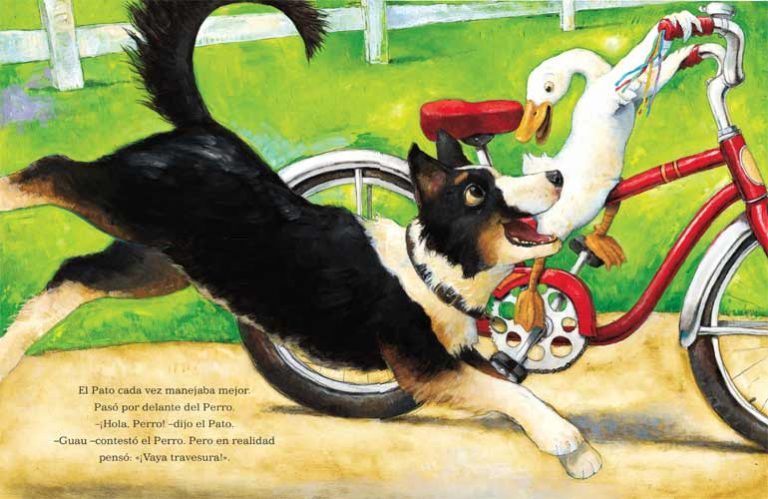
There are now an unprecedented number of children’s books in translation. When I taught Spanish in K-12 schools, I loved discovering new children’s books in translation. I taught Spanish in elementary schools for several of those years and enjoyed Spanish-language read-alouds during circle time. Some of my (and the kids’) favorite books to read were Pato en biciJust a Minute! (by the well-known author and illustrator Yuyi Morales), and Y si…. These three books are excellent for a language class because they combine both repetition and moments of surprise. This helps to solidify knowledge and keeps young readers engaged. Plus, the illustrations are so great.

An image from Pato va en bici by David Shannon, translated into Spanish by Elodie Bourgeois.

If a child in your life is learning another language, I highly recommend children’s literature in translation from Transit Children’s Editions. Transit Children’s Editions is an imprint of Transit Books, a nonprofit publisher of international and American literature based in the San Francisco Bay Area.

Any favorite books from your own childhood? If you have kids or work as a teacher, what books are you reading with them right now?

The AI Edition

Greetings, fellow humans! Yes, that’s right, this is a real human writing to you! 😊

I decided to call this post “The AI Edition” because I’m often asked about my stance on the use of artificial intelligence in translation work: Do I use it? Am I worried about my job? Will we have a chip planted in our brain one day, allowing us to speak any language we want? (Okay, maybe that last one is a little too apocalyptic.)

When or how to use AI is an important topic to discuss. My short and sweet answer is: I believe AI is a great tool for low-stakes needs with quick turnaround times. For example, perhaps you need to know the general idea of an email from an overseas client in a language other than your own, and you have to respond right away. Running the text through a tool like Google Translate or ChatGPT would be useful and quick.

I do not, however, recommend AI for most translation projects that need to resonate with a particular audience and require subject expertise. For example, a nonprofit institution will write up their annual report and include “calls to action” for their target audience to get more involved. This type of communication must connect deeply with the reader and uses specific vocabulary for the context. A few awkward words or phrases would have negative results. The type of work I do can’t rely on what is called “machine translation” or “generative AI translation.” If that’s enough of an answer for you, feel free to stop reading and go have that fancy coffee!

If you want to read on, I recommend three articles on this subject. The first article is understandably subjective: a “Statement on Artificial Intelligence” from the American Translators Association. The second article from PCMag is more objective and shows survey results from people who ranked different translation tools for their native language: “Google Translate vs. ChatGPT: Which One Is the Best Language Translator?”

The third article is a statement about the use of a “translation station” in public schools. This is a worrisome topic for those of us who provide translation in education because many items we translate for schools (IEPs, board meeting minutes, etc.) should be treated as legal documents. These are high-stakes documents for children and their families that deserve the time, care, and subject expertise a human translator can provide.

Share your thoughts with me in the comments. When do you like to use AI? When do you avoid it?

Language Access in Stakeholder Engagement

Last month, I attended a webinar hosted by the Europarc Federation called “Stakeholder engagement in conservation: Creating meaningful engagement for better conservation outcomes.” I was particularly interested in this topic because my translation work for clients in the land conservation field is a key part of stakeholder engagement, as it ensures language access and direct communication. The primary takeaways for me were how to identify and work with people with different “nature values,” how organizations can effectively work with local, national, and transnational interests, and what mediators do to help especially tense situations.

Kristian Bjørnstad, Director of Norway’s Regional Parks system, discussed the concept of “nature values.” He identified three main values: “nature for nature” (the intrinsic value of nature and a desire to protect it), “nature as culture” (seeing nature as part of one’s cultural landscape and history), and “nature for society” (seeing nature as something to benefit people so they can make a living and thrive). Kristian showed how learning and working with the nature values of different groups helped his organization to move forward with a project in Norway’s Varanger Peninsula.

A cluster of homes on the Varanger Peninsula

Hildegard Meyer, who works for the WWF, talked about engaging stakeholders from an NGO perspective. She currently works to increase wildlife corridors and core habitats in the Carpathian Mountains. The WWF had to act as a mediator, looking at the influence and power of different stakeholders. For example, local stakeholders may be private landowners. National stakeholders could be a country’s transit authorities and open space networks. Transnational stakeholders may be government bodies and the agreements they have to abide by. She showed how local, national and transnational entities were able to eventually work together as this project gets off the ground.

A rural community in the Carpathian Mountains, Romania

What happens when tensions are high and you’re getting nowhere? Mediator Eva-Maria Cattoen, who provides conflict management for the environmental sector, shared two case studies from Austria. One was especially contentious: Mountain bikers were using local forest land illegally for recreation, and landowners were fed up. She discussed how her firm helped to mediate the conflict and come up with solutions that satisfied common interests.

Cultural differences naturally come up in some of my translation work because different groups of people have different “nature values.” Communication with a particular group therefore needs to resonate with that group’s values. Communicating with an audience in their own language is also key to developing strong engagement. It can be a tricky balance, but with cultural know-how and the right methods of communication, it’s possible!

You can access the webinar and view the corresponding slides here: https://www.europarc.org/europarc-webinars/previous-webinars/stakeholder-engagement-in-conservation/

Images courtesy of redsavannah.com and lonelyplanet.com.