Working to Save Sea Turtles

A recent event in Costa Rica has me reminiscing about my time there. Today El País ran an article about the killing of conservationist Jairo Mora, a Ticowho worked to preserve sea turtles on the Caribbean coast of his country. This sad news highlights the high emotions that surround the preservation of sea turtles.

A baby turtle crawls out to sea.

Some Costa Ricans – and people in other countries – eat sea turtle eggs. They are harvested by digging up the holes where female turtles have laid their eggs. Sometimes the occasional dog will do the same, and it is well known that baby turtles scrambling to sea can be swooped up by a seagull for lunch. Human poaching, however, is much more dangerous to the turtles’ survival than natural causes.

I volunteered through PRETOMA at Ostional, a beach located along the Nicoya Peninsula on Costa Rica’s Pacific coast. I will never forget seeing the giant female turtles waddle up and out of the waves, slowly dig their nests, and drop the large, white eggs into the sand. One of our responsibilities was to count the eggs – a laborious task but nothing compared to the amazing cycle of nature we were watching. Another responsibility was our night patrol, making sure that nests were not being dug up. This was the tricky part, as some community members support conservation efforts, and others do not.

The "arribada" at Playa Ostional.
The “arribada” at Playa Ostional.

A comment from the El País article rang true for me: “Comida para hoy y hambre para mañana…Cuando ya no les quede más playas vírgenes para asfaltar ni árbol por talar, se darán cuenta que el dinero por si sólo no se come.”

Photo credits: costarica.com; fws.org

Calavera Love

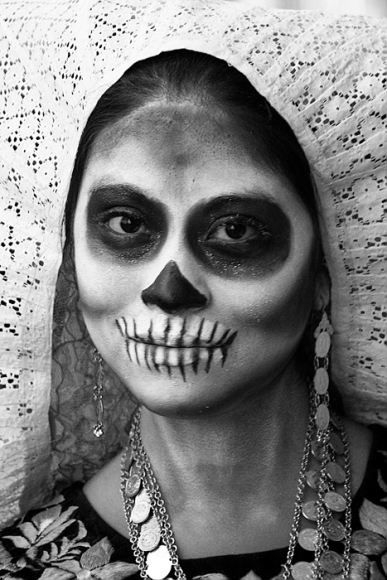
Día de los Muertos is just around the corner. Last year I posted pictures from here in San Francisco. This year I’m sharing some lovely, unique images. ¡Feliz Día de los Muertos!

calavera 1
Too cute.
If the afterlife is this, that's fine with me.
If the afterlife is this, that’s fine with me.
Haunting and lovely from Oaxaca.
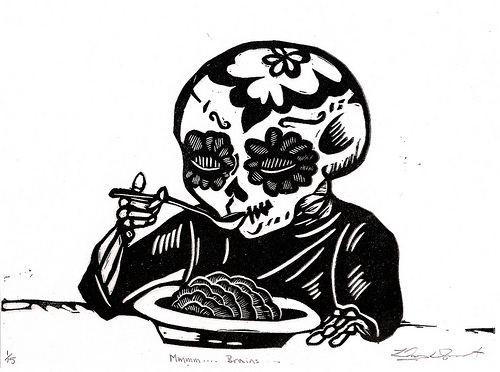
brains
This is titled “Mmm…brains.”
Nombres
Nombres

Photo 1 credit: photopin.com

Photo 2 credit: Illustration by Jose Pulido Art

Photo 3 credit: Wayne Hunthausen Photography

Photo 4 credit: Linocut by Lori Dean Dyment

Photo 5 credit: Pregunta Santoral

Homes to inspire

I just finished redecorating my bedroom. Along the way I encountered some beautiful design ideas from firms and individuals located in Spain and Latin America. In more rural areas of places like Costa Rica, nature is gorgeously incorporated in spaces like Casa Kike.

kike

This light-filled apartment in Bogotá, Colombia is a lovely oasis from the big city. I love the brick walls and large windows.

bogota

Lastly, I’ve always admired Spanish-style homes. Living in California, we have many gorgeous examples, and I especially like the ones that mix modern with traditional. Perhaps one day I’ll live somewhere with a real summer and can enjoy lazy afternoons on a patio like this, complete with olive tree:

Photo credits: Lush and Luxe, Gianni Botsford Architects,  and Houzz.com.

My Top 4 Tips for Language Learning

Image

I recently started taking Italian classes: Elementare Uno. So far I am thoroughly enjoying myself – I’d forgotten how wonderful it feels, after fumbling with words and tentatively mumbling a new verb conjugation, to be able to finally put a sentence together!

Being a language student has reinvigorated my understanding of the general student experience. It also reminds me of what us language teachers sometimes forget to talk about in class. So, here are my top four suggestions for students learning a new language. Thanks to my Italian school, Istituto Italiano Scuola, for reminding me!

1. Speak. Sorry, but you just have to. Eventually it just has to happen. This brings me to my next point….

2. Don’t be afraid to make mistakes. I know everyone says this. But it’s easier said than done. The best thing to do? Put yourself in your conversation partner’s shoes. If someone was trying to practice your native language, you would probably be excited to support and help them. You wouldn’t mind if they made a few – or even a lot of – mistakes. You’d probably feel honored that they are looking to you for support and help.

3. Grammar is important. But it doesn’t have to be perfect all the time. As a language teacher, I can be a stickler for grammar. But really, you don’t need exquisitely polished grammar to make friends, get around, and do what you need to do. The grammar will come in time.

4. “Keep your eye on the prize.” My dad has often shared this phrase with me, and I think of it all the time. Keep your language learning goals in mind. Why did you choose to learn a new language in the first place? To have amazing travel experiences? To meet interesting new people? To read articles and books? To eat delicious food? To communicate with someone you love and with their family? Keeping your goal in mind will help you through the rough patches.

So, that’s it from me! What are strategies that have helped you when learning a new language?

Photo credit: yourworldhere.com

Surrealism and Remedios Varo

I’m currently reading “Remedios Varo: Unexpected Journeys” by Janet A. Kaplan, professor of art history and executive director of Art Journal. Few books have been written about Remedios Varo, and Kaplan’s work, published in 1988, is a thorough journey into the artist’s life and gorgeous, captivating artwork.

Creation of the Birds, 1957

I first learned of Remedios Varo as an undergraduate in one of my Latin American art history courses. I promptly fell in love with the exquisite detail and storytelling element of her paintings. For a long time, Varo as a person remained a mystery to me…she was not discussed much in the course I took and I couldn’t find much of anything online or in the library about her. I even proposed writing my Honor’s thesis about Varo and fellow surrealist Leonora Carrington, and I was met with disinterest by anyone who could have been my thesis advisor! (Ah, the days before assertiveness.)

Born in Spain in 1908, Remedios Varo spent her childhood moving about the country with her family, as her father was an engineer and took on various projects in different regions. After fleeing the Spanish Civil War, she settled in Paris. There, she fully embraced the new Surrealism movement and experimented with dreamlike collages, drawings, and paintings – all while holding down a number of random jobs to stay afloat. With the onset of WWIII, she became one of many European refugees to be accepted into Mexico, where she lived the rest of her days, never to return to her mother country of Spain due to the Franco regime. It is in Mexico that her work truly blossomed and she gained most of her recognition. By this time she had also married, separated, and had a number of love affairs – something very different and daring at the time.

Celestial Pablum, 1958

I love two things the most about Varo’s work. First, she uses mathematical precision in her layouts and techniques. It is mind-boggling the amount of time and energy spent on each painting. Second, her stories are fantastical, wonderful, and imaginative. She imagines a completely different world and places the human being amidst it.  I dream of seeing her work in person, and until that day I can flip through the pages of Kaplan’s work to become immersed in the details and stories of Varo’s work.

Photo credits: venetianrednet, remediosvaro-simones.synthasite.compirringuinis.blogspot.com.

Ode to Perfumería Gal

perfumeria-gal-madrid-1Okay, time for a confession.

I’m addicted to chapstick. Lip gloss, vaseline, lip smoother – call it what you will, I am addicted. It’s been this way since I was a young girl and my mom, for example during a windy day on the ski slopes, would whip out her Chapstick brand lip gloss and encourage me to use it, too. It’s been downhill from there (no pun intended)…sometimes I feel like the girl in this funny video. Except you really don’t want to be around me if the chapstick goes missing.

So imagine my elation when I stopped by one of my local boutiques and saw that they are carrying my favorite lip treat of all time: Lip gloss from Perfumería Gal, Madrid. Just a glance at the small round tin filled with “vaselina perfumada” brings me back to living in Spain. I invariably had a different flavor of Gal lip gloss in every purse at the time. Today I bought the Violet scented gloss, which is my favorite.

Here are two historical pictures of Perfumería Gal I found:

ImageImage

Perfumería Gal began in 1870, and in the early 1900s owner Salvador Echeandía Gal introduced his perfumed lip balm. The company has been a mainstay of Spanish beauty products for generations. Many of their products feature beautiful Art Nouveau packaging. To see more historical photos of the Gal factories and employees, visit the blog Urban Idades.

Photos courtesy of Le rose aux joues and Urban Idades.